Monday, March 21, 2016
Friday, March 18, 2016
6 Bass Fishing Techniques You Need to Know

When it comes to bass fishing, there's so many different techniques out there, it's easy to get lost. If you're not sure where to start, we've taken six techniques that you really should know. These are time tested tournament winning tips that once mastered will bring your fishing game to another level. Our guide is packed with videos and detailed articles to make it easy for you to understand and put into action on the water. Check out The Top 6 Bass Fishing Techniques from BASSIN' USA!

Thursday, February 18, 2016
Get Paid to Fish Review
 If you’re looking to obtain and keep quality sponsors, the book “Get Paid to Fish” is a “must read”. It is packed with details that you better know if you are going to approach any company for sponsorship. Written by Bernie Barringer and Jim Kalkofen, whom both have over 20 years’ experience in fishing and outdoors activities, this book is the key to opening doors for those anglers who want to get paid to fish. It also offers some valuable insight not just from the writers, but from industry legends like Kevin Van Dam and Al Linder (to name a couple), detailing what it really takes to get a paycheck from a sponsor.
Of all the books and articles I have read over the years, Get Paid to Fish is one best that I have come across. It is well thought out, easy to read and easy to understand. It speaks directly to how Social Media, videos and other technologies can greatly benefit the anglers who are in the know. Whether you’re just starting out or if you have been at this for a long time, Get Paid to Fish can teach everyone a thing or two about sponsorships and what it really takes to get paid in the fishing industry. We were fortunate enough to catch up with Bernie Barringer (Co-Author of Get Paid to Fish) for a quick interview, here’s what he had to say: READ MORE
Monday, March 9, 2015
Finally some ice fishing!

Been trying to get out all winter for a little
#icefishing. Finally got a chance to get
out with my longtime friend Eric Fieldstadt (Great fishermen and photographer). If you’ve never been ice fishing, you might
be wondering why anyone in their right mind would want to walk out onto a
frozen lake or pond and start drilling holes.
The answer is simple… Addiction to Fishing!
There was about 15 people out on the ice when we
arrived. Action was slow in the early
morning, but picked up as it got later.
Several Crappie, Pickerel, Bluegills, Perch and even some Bass were
caught. Some guys set up “tip-ups”
rigged with live bait while they jigged.

We met a lot of nice folks out on the ice. Everyone was friendly, courteous and just out
there to have a good time.
Eric and I spent our time only jigging, but we moved around
a lot more than most of the guys out there.
We used a variety of ice jigs and some little spoons tipped with small
cuts of salmon skin. In the end, moving
around produced a lot more fish for us… plus you tend to stay warmer when you’re
moving around. ;)

If you’re thinking about giving ice fishing a try, there’s
still a lot you need to know before you set foot on the ice. I would always recommend you go with at least
one other person and preferably someone with ice fishing experience. Be prepared, dress warm and be sure to carry
some safety equipment. A good general
rule is 4” or more of newly formed ice is safe for one adult to stand on, but
there are other things to consider. Not
all areas will have the same ice thickness.
Here’s a couple of resources that can help you.

Thursday, July 24, 2014
Night Time Bass Fishing

In our latest article, we discuss some of the basics for night time bass fishing such as: Timing, Safety, Lighting, Pest Management, Lures, Colors and locations. If you haven't tried fishing at night, you're missing the boat.
Read On About Night Time Bass Fishing
Thursday, May 8, 2014
Mental Preparation A Must

If you were to ask a consistent winning tournament angler how they prepare for a tournament, I'd bet you dollars to donuts one of the items on their check list would be mental preparation. In fact many of the top competitors in any sport know that to win, you have to have your head in the game long before the game even starts. I'm sure it's not the first time you've heard this mentioned, but what does it really mean and how does one go about preparing themselves mentally for a fishing tournament? Here's what I like to do...
Bass Fishing Article Continued
Thursday, April 10, 2014
A Jig and What?

When early Spring arrives a lot of attention turns to a jig-n-pig combination for bass fish. This has long been a favorite, and rightfully so, as it is a great producer for lunker bass. However, during the last two seasons I’ve found a smaller and slimmer jig combination. The combination, which I found to be very productive, is the black/purple, Gripper Hair Rubber Bass Jig with a 4-inch, black Mann’s Jelly Worm. For added attraction, Kodiak Crawfish Paste is applied to the blackberry scented worm trailer.
Early Spring Jig Fishing continued...
Wednesday, March 26, 2014
Bank Fishing
 People always ask me if I still like to fish from the banks or shorelines since I have a boat and compete in tournaments. My answer is always YES. In fact, my favorite part of shoreline fishing is that you don't need a lot of time to go. Here's a nice bass I caught during a lunch break from work.
I've been bass fishing since I was a kid and fishing from the shoreline was my only option for quite some time. I will admit that having a boat has advantages, the ability to cover far more water in less time. But even as a boat owner, I haven't forgotten my roots.
You don't always need a boat to catch a big bass. As matter of fact, one of my personal bests to date was caught bank fishing. Never underestimate fishing from shorelines of a lake or pond. Every body of water has at least one dominant bass.
There are a few tips I follow that have helped me be more successful when fishing from the bank.
Here are some bank fishing tips:
- Fishing equipment or gear
Less is more. Better to pack lite so you can move around more freely and cover more water. The more spots you hit the better chance you have landing a big bass.
- How to approach the shoreline
Bass spook easily, especially lunkers, so make sure that you are quiet when you approach the shoreline.
- What to look for to find bass
Big bass like heavy cover on the bank. When you think of cover think of weeds, branches in the water, shade, basically anything a bass can use to “cover” itself. Make sure you have polarized glasses, they really help to find underwater structure and cover.
- Different Casting techniques
Shoreline access is usually limited and surrounded by obstacles. Being proficient in as many casting techniques as possible, will increase your ability to place a lure into key areas.
Check out my article on bank fishing tips. There, I explain in more details how to apply each of these tactics and techniques.
Whether you have a boat or not, never underestimate fishing the banks of a lake or pond, they can produce some really nice bass.
Friday, March 14, 2014
Ice Out Bass Tactics


Locating Bass
Largemouth and Smallmouth bass can be found in many locations from steep bluff walls with stair-stepping ledges to shallow, dark bottom areas near rocks and weeds where there’s more heat. The one common factor you need to search for is the transition areas that bass will use to get from deep to shallow. On larger man made impoundments, old road beds, creek channels and stone walls can be used as a road map that shows you how bass will move from point to point:
A (wintering holes) to
B (deep transitional structures, bluffs, rock ledges, points, etc.) to
C (shallow transitional structures like rock piles, docks and emerging weed beds) to
D (Spawning flats)
Read More Finding Bass When the Ice Melts
Saturday, March 8, 2014
Tackle Giveaway Register Now!
Register now for your chance to win a BASSIN' USA.com Hat and two packs of Havoc baits autographed my Mike Iaconelli courtesy of Northern Bass Supply...
To register simply fill out our registration form. You must put "Havoc Bait Giveaway" in the subject line to be enter into our drawing. All entries must be submittted before Midnight (EST) March 31, 2014.
CLICK HERE TO REGISTER!
Monday, March 3, 2014
Rockland County Hunting and Fishing Expo - 2014

We have some great video footage coming soon as well as some give away items including two packs of Havoc baits autographed my Mike Iaconelli courtesy of Sandra at Northern Bass Supply!
Bobby Uhrig founder of Mega Strike was also kind enough to donate a gift BASS-kit loaded with lures from Mega Strike which will also be giving away.
Visit Bass Fishing at BASSIN' USA.com for more details!
Thursday, February 6, 2014
Consolidate your Bass Fishing Tackle
On the Bassinusa.com message boards there's a discussion about limiting the amount of lures that they carry on their boats. There's such a vast amount of lures out there that we use for different techniques. We try to consolidate in the beginning of the season, but as one of our members posted "by mid-season there will be a small tackle shop in the boat!"
What do you do to limit the amount of clutter in the boat?
Here's what I've done to help keep the clutter to a minimum.
I've started creating smaller boxes that contain everything I need for a specific technique. Plano makes a great waterproof tray model 3640-10 that allows you to separate the interior layout in some very usable configurations:
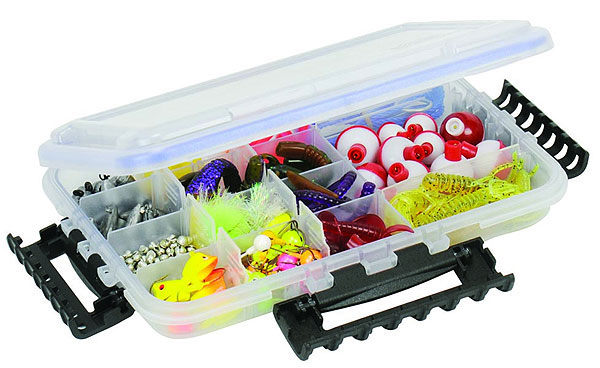
For example, drop shotting. I have a small dropshot box that contains my three top producing colors which mimic the forage in the areas that I am fishing. (When traveling to other areas, I can swap out colors as needed), Weights I keep loose in the compartment on the right along with hooks which I leave inside their plastic jacket. I mostly use Gamskatsu hooks, so the package fits nicely inside this size box.
I have another one setup for jigs, swimbaits, grubs, tubes, etc.
For jig heads, I keep a separate box (same size) with a variety of the jig heads that I commonly use.
I one larger box that I use for bulk hooks, weights and other terminal tackle (swivels, split rings, etc.)
Like you suggested, I also have combined my crankbaits into one box, with a variety of colors and sizes sorted by Depth. I like a double sided box for this. I'll put 0' -12' on top and the Over 12' on the bottom (or other side).
Top water lures I keep in a medium size box that can hold about 15-20 lures (depending on size).
I have a spinnerbait/buzzbait box:

What do you do to limit the amount of clutter in the boat?
Here's what I've done to help keep the clutter to a minimum.
I've started creating smaller boxes that contain everything I need for a specific technique. Plano makes a great waterproof tray model 3640-10 that allows you to separate the interior layout in some very usable configurations:
For example, drop shotting. I have a small dropshot box that contains my three top producing colors which mimic the forage in the areas that I am fishing. (When traveling to other areas, I can swap out colors as needed), Weights I keep loose in the compartment on the right along with hooks which I leave inside their plastic jacket. I mostly use Gamskatsu hooks, so the package fits nicely inside this size box.
I have another one setup for jigs, swimbaits, grubs, tubes, etc.
For jig heads, I keep a separate box (same size) with a variety of the jig heads that I commonly use.
I one larger box that I use for bulk hooks, weights and other terminal tackle (swivels, split rings, etc.)
Like you suggested, I also have combined my crankbaits into one box, with a variety of colors and sizes sorted by Depth. I like a double sided box for this. I'll put 0' -12' on top and the Over 12' on the bottom (or other side).
Top water lures I keep in a medium size box that can hold about 15-20 lures (depending on size).
I have a spinnerbait/buzzbait box:
I keep a Plano box that holds all my fishing line and another stand-up bin that holds pliers, glue, scissors, flashlight, and other tools, etc.
I have a small mesh bag that holds my culling scale and rings (up to 10)
Everything fights into one bag that fits in the back compartment of my Ranger. That's the test, if I can keep everything down to that size, if I ever need to jump in someone else's boat, I'm good to go...
From there, I keep bulk plastics in big zip lock freezer bags that can be left in a bin which can be left at a hotel, or the truck and if I'm really paranoid, I can always through a couple in the boat compartments because there' usually plenty of room left over.
Tuesday, August 27, 2013
Crankbait Tips - Off-Shore

Thursday, August 22, 2013
The New Technique Hump

As the day goes on your friend catches fish while you end up catching nothing or panfish. Towards the end of the day you put it down and pick up ol’ reliable and catch a fish or two. When you get home all the new tackle and the technique go right into the spare tackle box, and you have convinced yourself that it’s all hype. I can admit, that once upon a time this was me, but a close friend of mine told be about how I could overcome this way of thinking and expand.
The first thing you should consider is .... READ MORE
Bass Fishing Articles
Friday, August 16, 2013
The Right Fishing Rod & Reel

The first setup is a 6”6” Med Heavy graphite bait cast rod paired with a high speed bait cast reel, like a 7 to 1 ratio. This is a good all around rod that can be used for fishing worms, jigs, senkos, spinnerbaits, Carolina rigs and even jerkbaits. There are a couple of options you can choose on a rod. Some anglers prefer a solid handle, while others want the split grip which reduces the overall weight of the rod. Both are great choices and it basically comes down to personal preference and what feels good in your hand. The graphite component rod gives you the feel you need to detect a strike and feel your lure moving through cover. I chose a high speed reel for this set up which will give you the ability to take up more line per each turn of the reel handle which is an advantage when fighting a fish. It also will allow you to move the bait more quickly and burn a spinnerbait with little effort.... READ MORE
Thursday, March 7, 2013
Humminbird 360 and Minn Kota iPilot Link
Last weekend we headed up to Suffern, NY for the World Fishing and Sports Show, which was great. We got an opportunity to speak with Bill Carson from Johnson Outdoors about the Humminbird 360, Minn Kota iPilot Link and Lake Master® Mapping.
When it comes to finding fish these guys definitely prove why they are the leading innovators of fish finders.
Check out our video interview with Bill Carson.
Features of the Humminbird's 360 Imaging accessory:

Ability to mark waypoints anywhere on the 360 Imaging screen
An audio alert is given when the boat nears a waypoint within casting range
Capable of recording video and screen captures
Eight color palettes
Four sonar speed settings
Specific area can be selected and zoomed in on
THIS IS I-PILOT® LINK™, THE GAME CHANGER IN BOAT CONTROL

Like Us on facebook
When it comes to finding fish these guys definitely prove why they are the leading innovators of fish finders.
Check out our video interview with Bill Carson.
Features of the Humminbird's 360 Imaging accessory:
Ability to mark waypoints anywhere on the 360 Imaging screen
An audio alert is given when the boat nears a waypoint within casting range
Capable of recording video and screen captures
Eight color palettes
Four sonar speed settings
Specific area can be selected and zoomed in on
THIS IS I-PILOT® LINK™, THE GAME CHANGER IN BOAT CONTROL
For more information about these new technologies visit Humminbird and Minn Kota
Like Us on facebook
Tuesday, September 25, 2012
River System Topwater Fishing

A topwater can pay off for you if you give it the chance and put the typical misconceptions out of your mind. Topwater baits can be dynamite during all hours of the day and are more versatile than most realize. I agree that early, late, spring, and fall are the prime times for the surface lure. But anglers who believe this is the only time are really limiting their ability to catch bass.
Rivers are excellent for topwater fishing because in this swift environment bass live in less than 5 feet of water. When fishing current with a topwater plug there are a few things to think about. The position of the fish and the angle in which the current will move your bait. Always through 3 feet or farther past your target, so you won't spook the fish, and move the bait with the current as close to the target as possible. Lures of choice are the Zara Spook Jr., Spitting Image, Cotton Cordell's Crazy Shad, and the Tiny Torpedo.
So the next time you're on a river system and the bite is slow, tie on that old topwater plug. You'll be surprised.
SOURCE
Friday, June 22, 2012
How to Tie a Blood Knot
Here's a modified way to tie a blood knot... The blood knot is great for joining two types of fishing lines together. It works especially well for joining braided line to fluorocarbon line. Hope you find this helpful. If you already know this knot, there's an unrelated funny clip at the end of the video (2:55 min in)
Thursday, June 7, 2012
Tuesday, May 8, 2012
Know the Flow - Spring Bass Fishing Tactics
 Everyone thinks “a bass is a bass no matter where you go“; Lake Fisherman
will say that bass relate to the same cover and that bass move the same way on
any body of water. Well, myself, and a lot of river rats know that’s not
true!!
Everyone thinks “a bass is a bass no matter where you go“; Lake Fisherman
will say that bass relate to the same cover and that bass move the same way on
any body of water. Well, myself, and a lot of river rats know that’s not
true!!Rivers add a different mix of situations to deal with, current and water fluctuations are two of the major issues to contend with on river systems. In the spring it’s the most crucial piece. Water movement can change the movement of the bass and start or stop the pressman migratory run to the shallow water spawning bed. One of the best tools to use to get update info on your water levels is the Army Corp of Engineers river gauge reader. This reader is the actual water level read out that the Army Corp Lockmasters has allowed to flow in and out of the locks. This read out can change every day or every hour. You can get this piece of info by going to the Army Corps Website or calling your local river lockmaster! This information tells you how much water flow have come in & how much water is flowing out of those locks, you can use that information to help make better decisions on where the bass will move into to, and where the bass will spawn.

When bass move up to spawn & the water flow is strong and rising, normally the bass are easier to catch, but with high water comes dirty water so sight fishing becomes impossible. When bass move in to spawn & the water levels start to drop the bass don’t leave their beds, however bass become very spooky so you have to make long casts & use finesse presentations to get them to bite. Some the lures I like to use are finesse worms, Sinkos and my favorite is a Horny Toad lure. Mainly, I use baits that don’t make a lot of noise.
Bass don’t like strong currents when it comes to spawning time so look for areas that don’t have a lot current when looking for spawning bass (canals, chutes, backwater areas & any current break areas). Low water during the spawn look for areas with quick access to deeper water (bluffs, points, deeper pockets & marinas). Knowing your river current flow by checking your water levels will give you a better understanding on where to concentrate your time to get the most productive bite!!!!
By Marques Green - BASSIN' USA PROSTAFF TEAM
Subscribe to:
Posts (Atom)